
Coconut Shell Charcoal vs. Hardwood Lump: Which is Best for Shisha and BBQ?
A simple but detailed guide for international importers, shisha lounge owners, restaurants and charcoal distributors. Learn how coconut shell briquettes and natural hardwood lump charcoal differ in burning time, heat, ash, smoke, smell, packing and export supply from India.
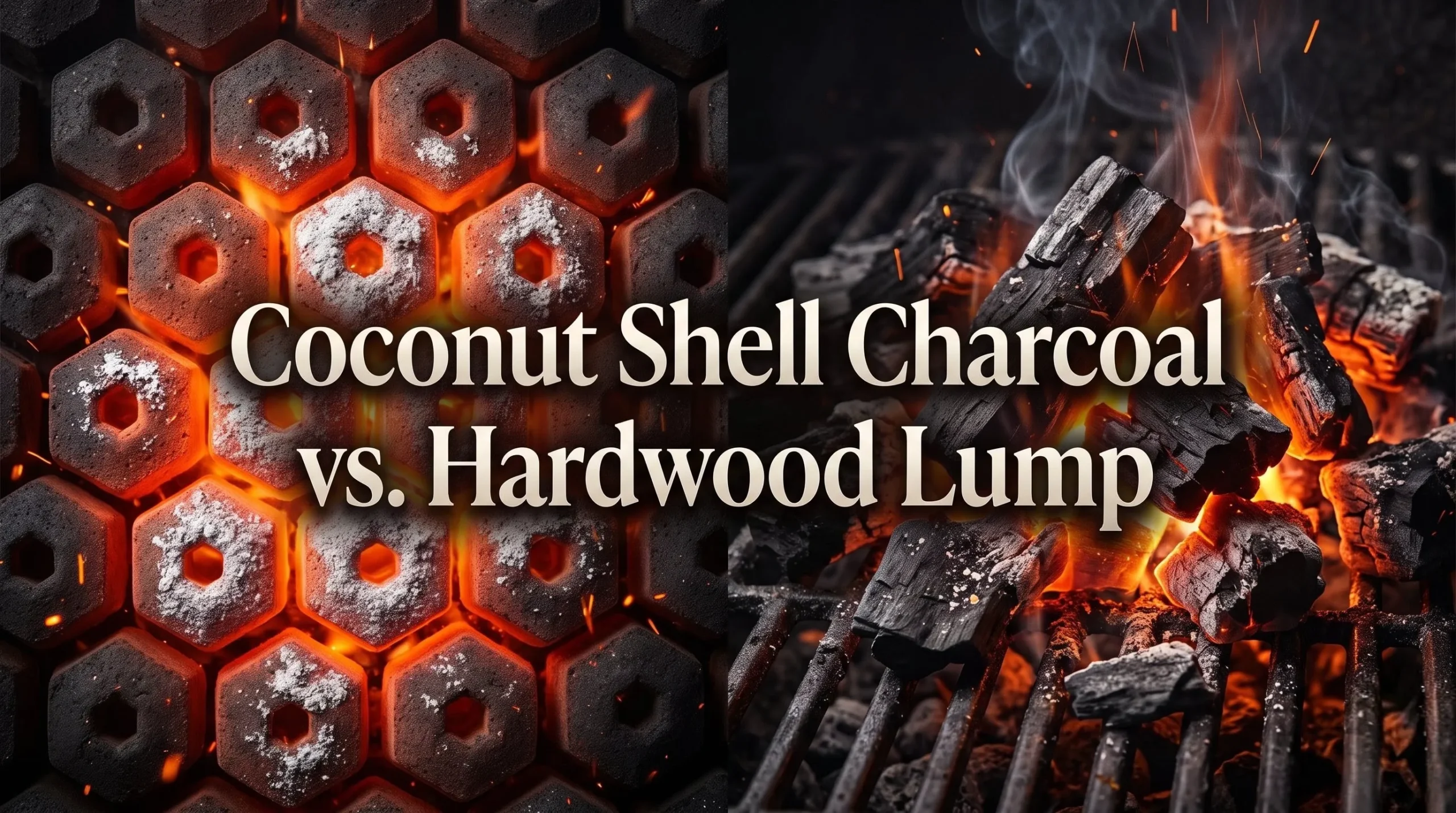
If you are buying charcoal for a shisha lounge, BBQ restaurant, steakhouse or wholesale distribution business, one question matters: Should you choose coconut shell charcoal or hardwood lump charcoal?
Both products are made by heating natural material in a controlled way so that much of the original material changes into charcoal. But they are not the same product. They do not always burn in the same way, make the same amount of ash or suit the same customer.
Think of it like this: coconut shell charcoal is usually pressed into neat, dense pieces. Hardwood lump charcoal is usually sold as natural, irregular pieces of carbonised wood. One is often chosen for steady, controlled heat. The other is often chosen for fast heat and a natural wood-fired cooking experience.
In this guide, we explain the difference in very simple language, then look at the technical details that matter when buying in bulk. We will also explain what international buyers should check before placing an order with a coconut shell charcoal exporter India or a supplier of hardwood lump charcoal wholesale.
The short answer: coconut shell briquettes are often a strong choice for shisha and steady BBQ cooking. Hardwood lump charcoal is often a better choice for restaurants that want quick, intense heat and a natural wood aroma. The best choice depends on how you plan to use it.
The Quick Answer: Which Charcoal Should You Choose?
Coconut Shell Charcoal Briquettes
A good option for shisha lounges and buyers who want shaped pieces, low ash, steady heat and a clean-burning product when properly made and used. Hookah-grade briquettes in our catalogue have an indicative burn time of 90–150 minutes.
Hardwood Lump Charcoal
A good option for BBQ kitchens, steakhouses and open-fire cooking where quick lighting, strong heat and a natural wood-fired aroma are important. The pieces are irregular because they come from carbonised wood.
There is no single charcoal that is best for every buyer. The right product is the one that matches your equipment, cooking style, customer expectations and required test results.
Buyer tip from Perumala OverseasWhat Is Coconut Shell Charcoal? Best for Shisha and Long BBQ Sessions
Coconut shell charcoal starts with the hard shell left after the coconut meat and water have been used. Instead of throwing that shell away, it can be turned into charcoal.
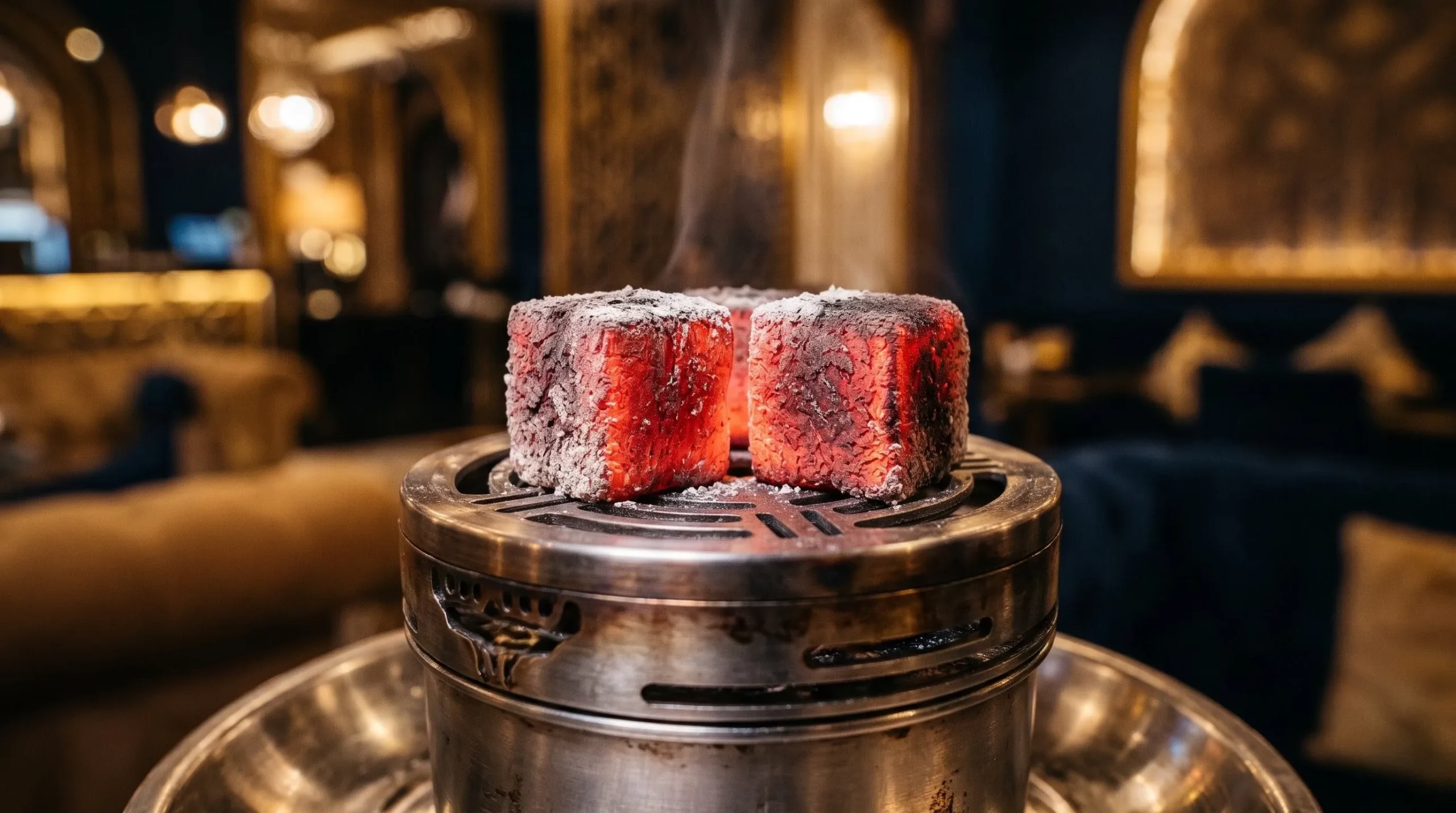
How is coconut shell charcoal made?
Let us explain it in easy steps. First, coconut shells are collected and dried. Next, they are heated in a low-oxygen process called carbonisation. This removes much of the water and other materials that would otherwise burn away.
The result is coconut shell charcoal. For briquettes, the charcoal is crushed into powder, mixed with a suitable binder and pressed into a chosen shape. The pieces are then dried so they become firm enough for handling and packing.
- Collect the shells: The hard outer shells are gathered as the raw material.
- Dry the shells: Excess moisture is reduced before processing.
- Carbonise: The shells are heated with limited oxygen to make charcoal.
- Crush and prepare: For briquettes, the charcoal is ground into a fine powder.
- Mix and press: The powder is mixed with a suitable binder and pressed into cubes, fingers or hexagonal shapes.
- Dry and check: The briquettes are dried and checked against the agreed product specification.
Why do shisha lounges often choose coconut shell charcoal?
Shisha users usually want the tobacco flavour to remain clear. They do not want the charcoal to add a strong unwanted smell or smoke to the session. Properly manufactured hookah-grade coconut briquettes are designed for this purpose.
Our charcoal catalogue lists premium hookah/shisha briquettes made from coconut shell charcoal powder with a food-safe binder. The indicative catalogue specifications include fixed carbon of 82–90%, ash content of 2–4%, moisture of 4–6%, and a burning time of around 90–150 minutes. The catalogue describes the product as odourless and smokeless.
These are product-range figures, not a promise that every batch will have exactly the same result. Actual performance depends on the production batch, briquette size, airflow, lighting method and how the charcoal is used. Buyers should approve a sample and agree on test methods before ordering in bulk.
What does “smokeless hookah charcoal” really mean?
In simple words, it means the charcoal is designed to produce very little visible smoke and unwanted smell after it has been properly lit and has reached the correct burning stage. It does not mean that lighting charcoal creates absolutely no emissions.
Always light charcoal in a suitable, well-ventilated area and follow the instructions for your equipment. Burning charcoal produces carbon monoxide, which is dangerous and cannot be seen or smelled. Never burn it in an enclosed room without proper ventilation.
What shapes can buyers order?
Cube briquettes
Commonly used for hookah and shisha. Catalogue options include 25 mm and 26 mm cubes, subject to confirmation.
Finger briquettes
Longer pieces that can suit selected charcoal burners and heating applications, depending on the equipment.
Hexagonal briquettes
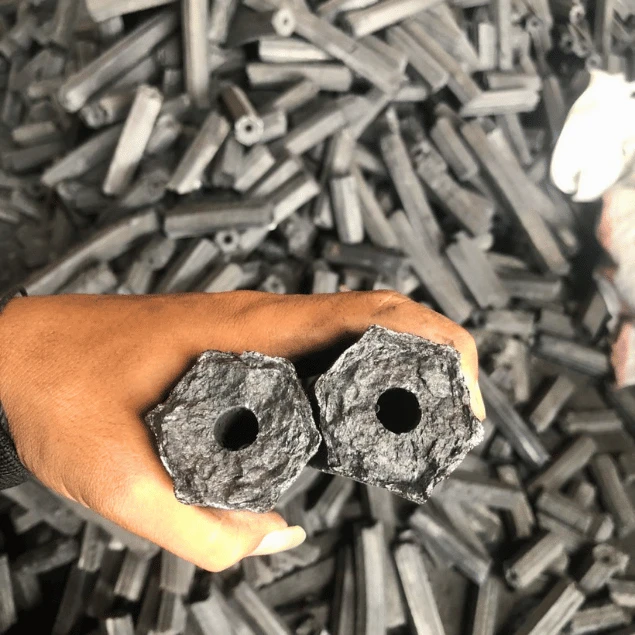
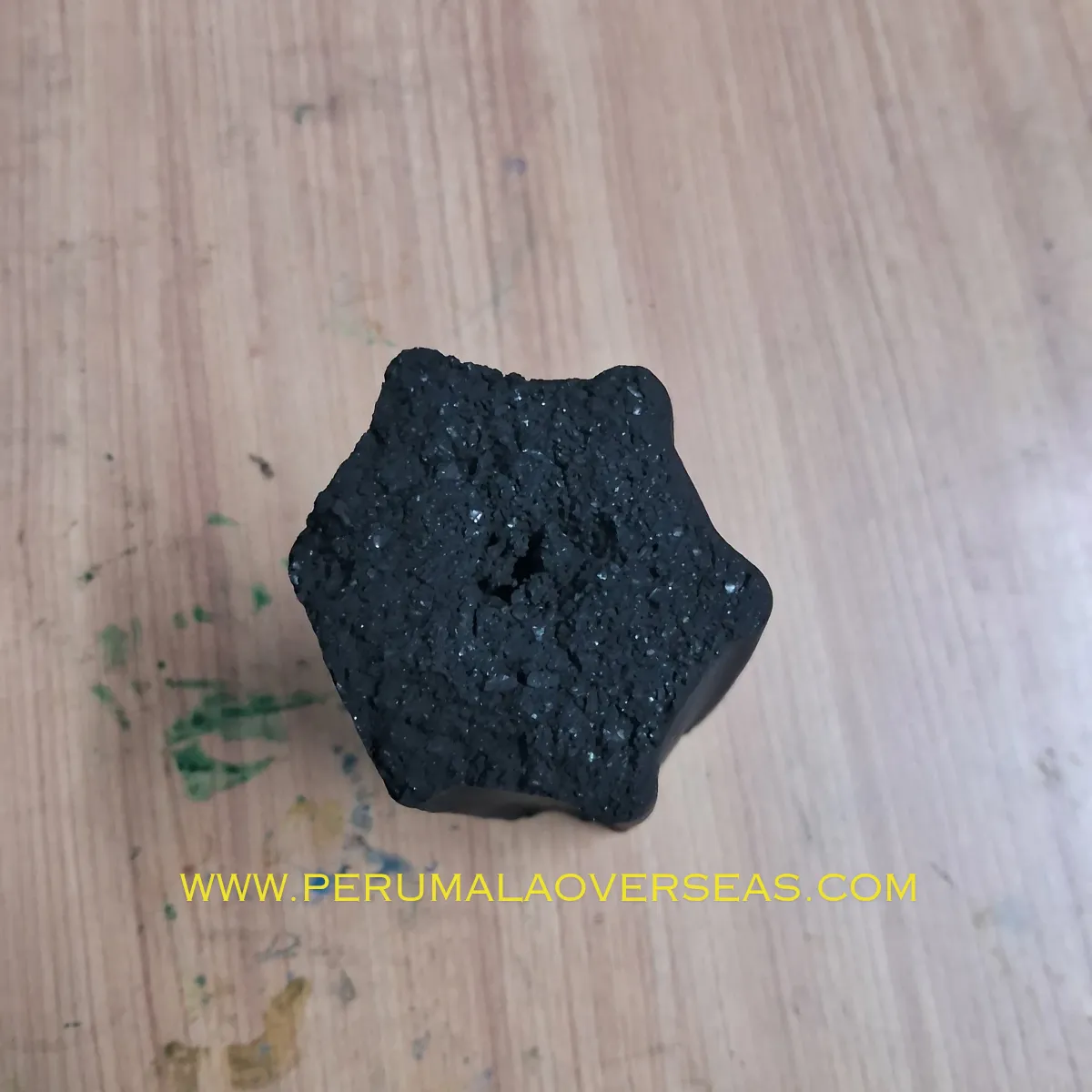
Pressed pieces with a six-sided shape. The centre hole, dimensions and length should be specified by the buyer.
Pillow briquettes
Rounded or pillow-style pieces used in some BBQ and cooking applications.
Can coconut shell charcoal be used for BBQ?
Yes. BBQ-grade coconut shell briquettes are used by restaurants, caterers and home BBQ buyers who want steady heat over a longer cooking period. They are made for cooking applications and are different from hookah-grade briquettes.
Our catalogue lists BBQ-grade coconut shell briquettes with fixed carbon of 75–82%, ash content of 3–6%, moisture of 5–8%, and an indicative burning time of 2–4 hours, depending on size and conditions. Available shapes include hexagonal, pillow and cube.
If you are buying for a restaurant or BBQ distributor, make sure you ask for the BBQ grade rather than assuming that every shisha briquette is suitable for your cooking equipment.
View Coconut Shell Charcoal Briquettes for product information and wholesale enquiries.
What Is Hardwood Lump Charcoal? Best for High-Heat Steakhouses and Fast Grilling
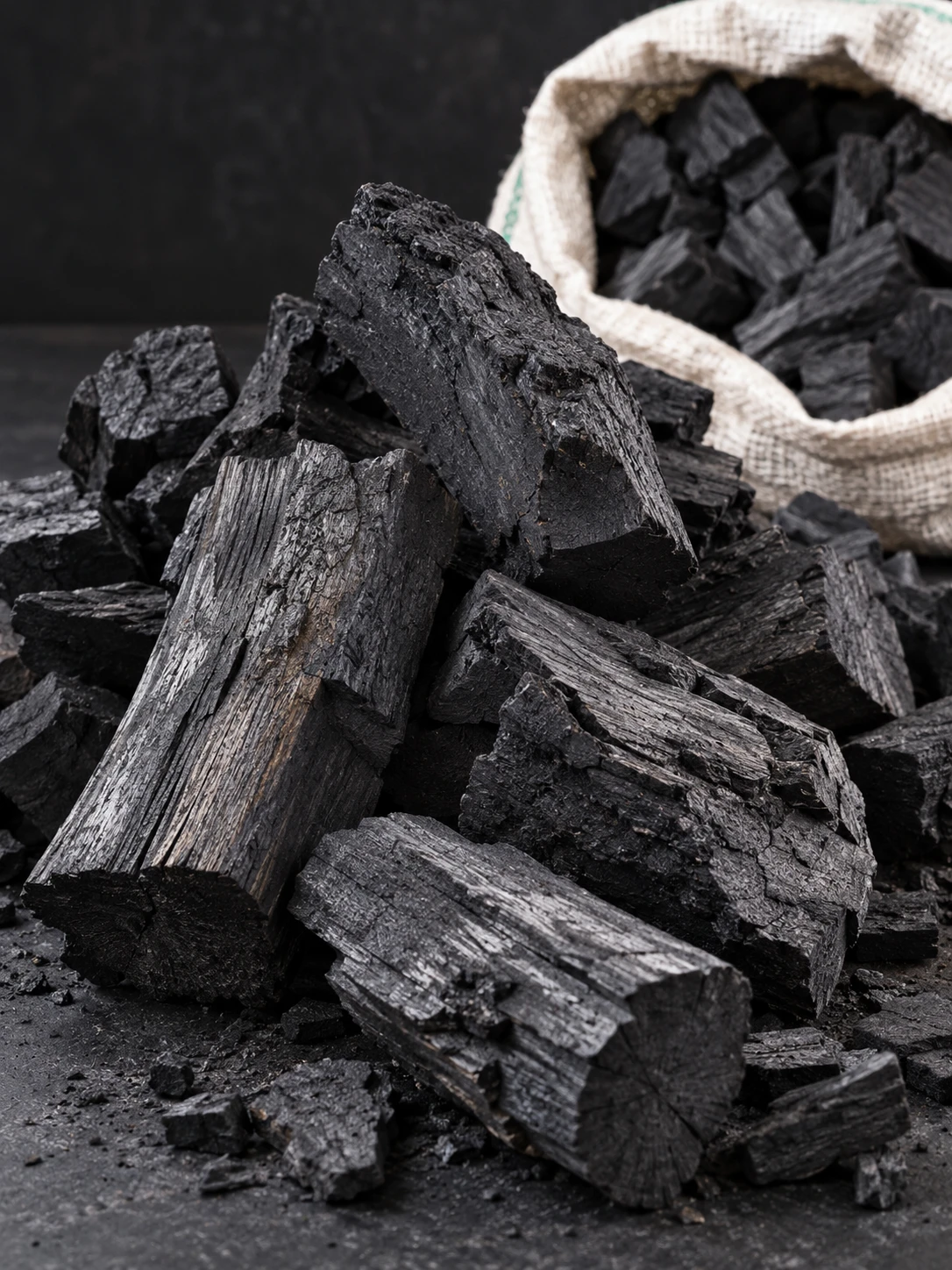
Hardwood lump charcoal is made from real wood. The wood is heated with limited oxygen until it becomes charcoal. It is then sorted into pieces of different sizes.
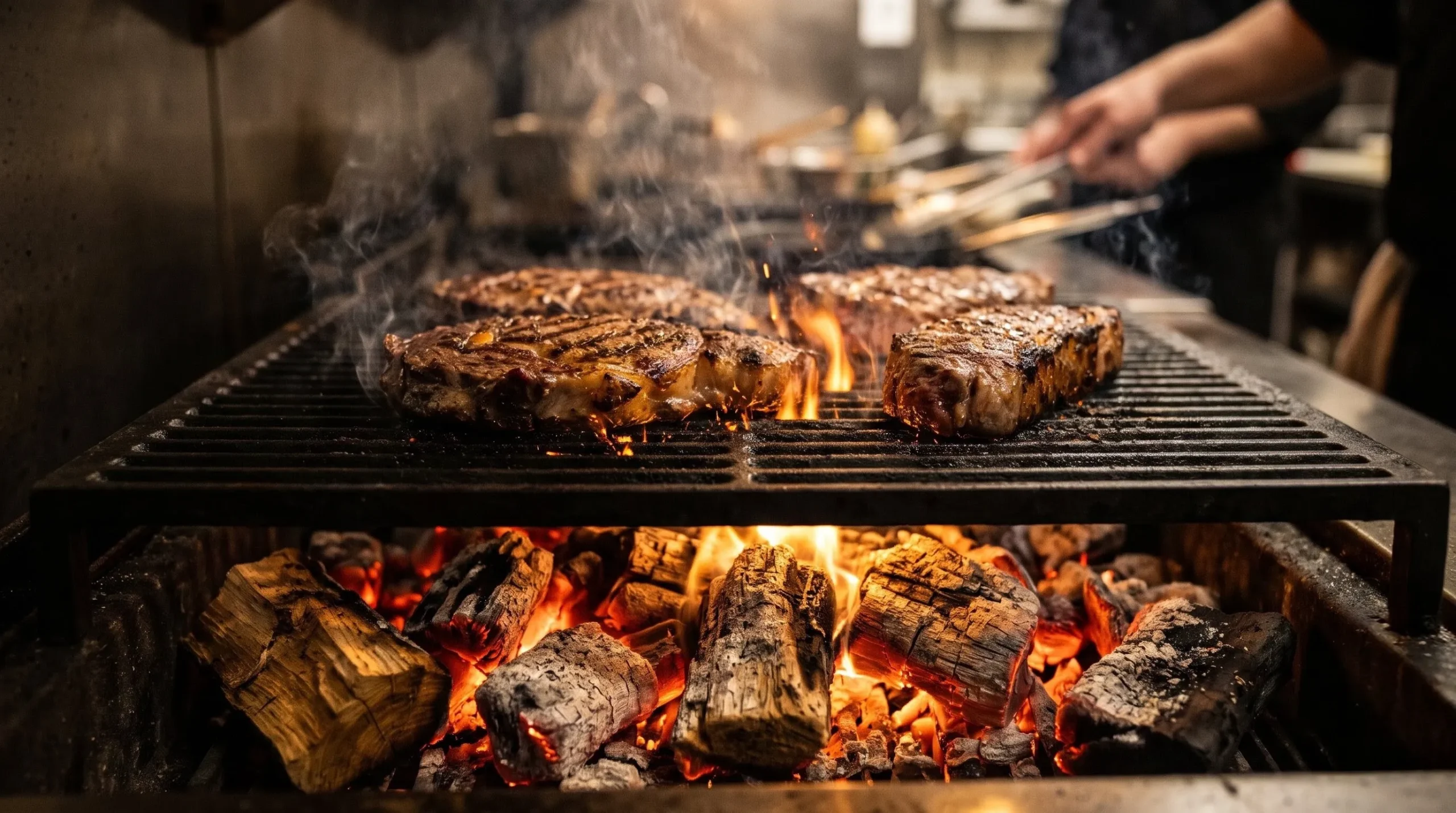
How is hardwood lump charcoal made?
Think of a dry piece of wood placed in a special kiln. It is heated with limited oxygen. The wood does not burn in the same way as it would in an open fire. Instead, much of its moisture and volatile material is driven off, leaving a carbon-rich solid.
After cooling, the charcoal is broken or sorted into different sizes. Unlike briquettes, lump charcoal is not normally crushed into powder and pressed into identical shapes. Each piece can look different.
Why do steakhouses and BBQ restaurants use hardwood lump charcoal?
Hardwood lump charcoal is popular in many open-fire kitchens because it can light relatively quickly when the pieces are dry and correctly sized. It can also reach high cooking temperatures, which are useful when a chef wants to sear meat or cook over a strong fire.
Different wood species can produce different aromas. Some chefs like the natural wood-fired character that can come from cooking over hardwood charcoal. The smell and flavour depend on the wood species, carbonisation process, cooking method and food being prepared.
What hardwood is used?
Perumala Overseas' charcoal catalogue lists Acacia, Prosopis juliflora and mixed hardwood as possible raw materials for its hardwood lump charcoal range. The exact wood type should be confirmed for each offer and shipment.
This matters because wood species, piece size, moisture, carbonisation and storage can all affect how the charcoal lights and burns. Buyers who need a particular wood type should put that requirement in the purchase specification.
What are the indicative technical specifications?
The catalogue gives the following indicative range for hardwood lump charcoal:
- Fixed carbon: 68–80%.
- Ash content: 4–12%.
- Moisture: 6–12%.
- Calorific value: 6,200–7,200 kcal/kg.
- Common size options: 20–50 mm, 40–120 mm and custom sizes, subject to confirmation.
These are catalogue ranges. The final specification should be agreed for the actual grade being purchased. Buyers should request a current batch report or independent test where the values are important to their operation.
Is hardwood lump charcoal always better for high heat?
Not always. It can be a good choice for fast, high-heat grilling, but the result depends on the charcoal grade, wood type, size, moisture, airflow and cooking equipment. A well-made briquette can also provide strong heat.
A restaurant should test the charcoal in its own grill before changing its regular supply. The best product is the one that gives the kitchen the heat, cooking time and flavour it needs at a workable cost.
Explore Hardwood Lump Charcoal for product details and sourcing enquiries.
Coconut Briquettes vs Hardwood Lump: Burn Time, Ash, Smoke and Heat
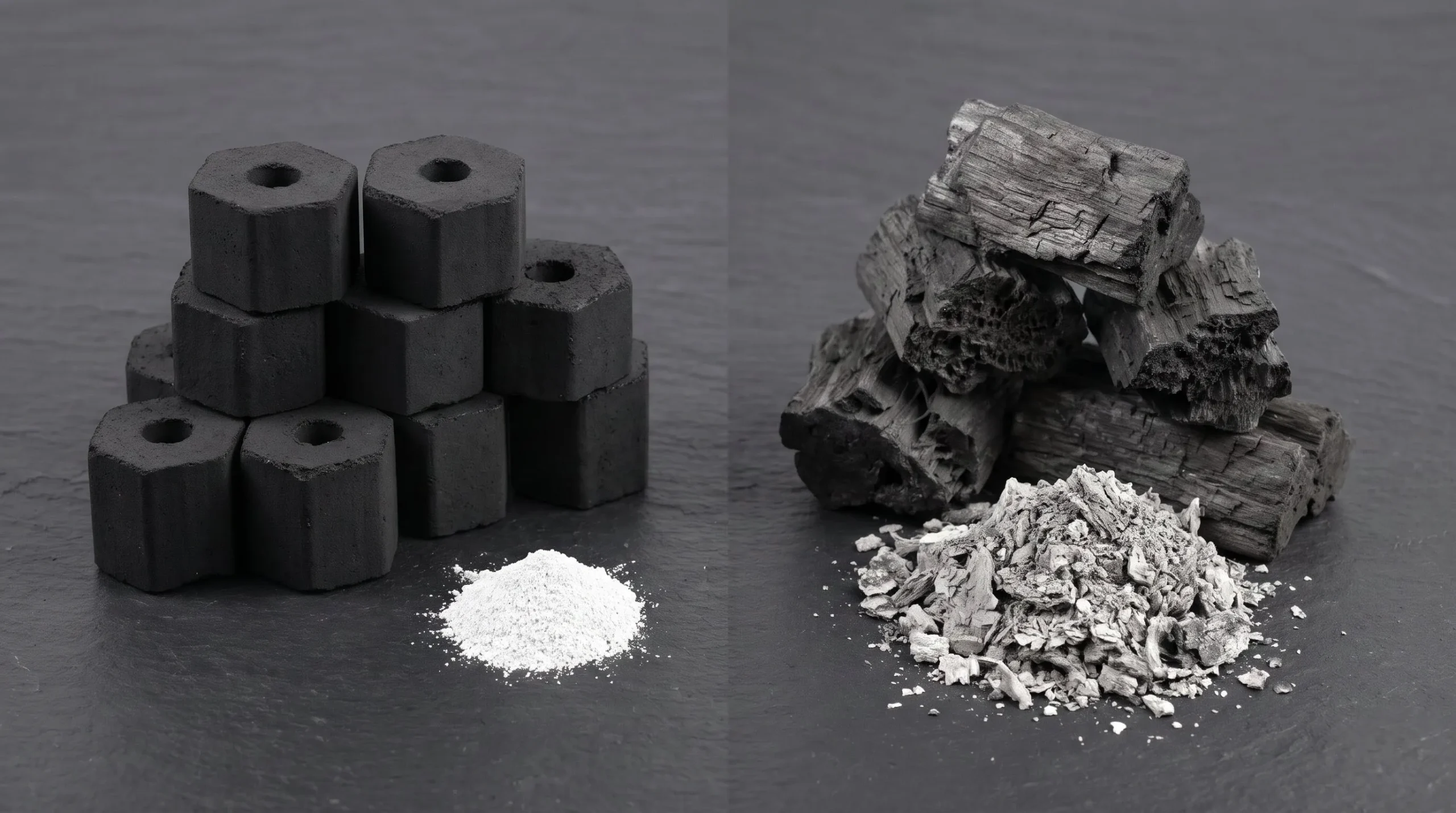
Now let us put the two products next to each other. This table helps buyers understand the main differences before asking for a quotation or sample.
| Comparison | Coconut Shell Briquettes | Hardwood Lump Charcoal |
|---|---|---|
| Raw material | Carbonised coconut shells, crushed into powder and pressed with a suitable binder. | Natural hardwood pieces carbonised into irregular lumps. |
| Burn time | Hookah grade: around 90–150 minutes in the catalogue. BBQ grade: around 2–4 hours, depending on size and conditions. | Varies with wood type, piece size, moisture, airflow and grill conditions. Confirm by sample testing for the required application. |
| Ash content | Hookah grade: 2–4%. BBQ grade: 3–6%, according to the catalogue. | Catalogue range: 4–12%. A 5–8% result may occur for some grades, but it should not be treated as a fixed specification. |
| Smoke and odour | Premium hookah grade is designed for low visible smoke and low unwanted odour after proper lighting. BBQ grade performance depends on its formulation and use. | Can produce a natural wood-fired aroma. Smoke and smell depend on the wood, carbonisation, moisture and lighting conditions. |
| Ignition time | Often needs a suitable electric burner or charcoal lighting equipment. Allow enough time for the whole piece to become properly lit. | Can light relatively quickly when dry and correctly sized, but actual lighting time depends on the equipment and airflow. |
| Heat consistency | Uniform shapes and density can help provide more predictable heat when briquettes are made consistently. | Natural pieces vary in size and shape, so heat output can vary from piece to piece. |
| Best application | Shisha lounges, hookah use and selected BBQ applications, depending on grade. | Open-fire BBQ, steakhouse grills, restaurants and cooking applications that want natural lump charcoal. |
What is fixed carbon?
Fixed carbon is the part of charcoal that remains after moisture and volatile materials are measured or removed through the relevant test process. In simple words, it helps describe how much carbon-rich solid fuel is in the product.
A higher fixed-carbon result can be useful when comparing charcoal grades, but it does not tell the whole story. Buyers should also look at ash, moisture, size, calorific value, strength and actual burning performance.
What is ash content?
Ash is the solid material left after charcoal has burned. Imagine burning a piece of charcoal and looking at what remains. That leftover powder is ash.
Lower ash can mean less residue to clean from a grill or shisha tray. But the right limit depends on the buyer's application. A buyer should agree on an acceptable ash percentage and the test method before ordering.
What is calorific value?
Calorific value tells you how much heat energy a fuel can release when it burns completely under a defined test. It is usually shown in kcal/kg or MJ/kg.
A higher number can indicate more energy per kilogram, but it does not automatically mean the product is best for every grill or burner. Heat control, airflow, burn duration and equipment design also matter.
Charcoal Product Samples: Look at Shape, Density and Piece Size
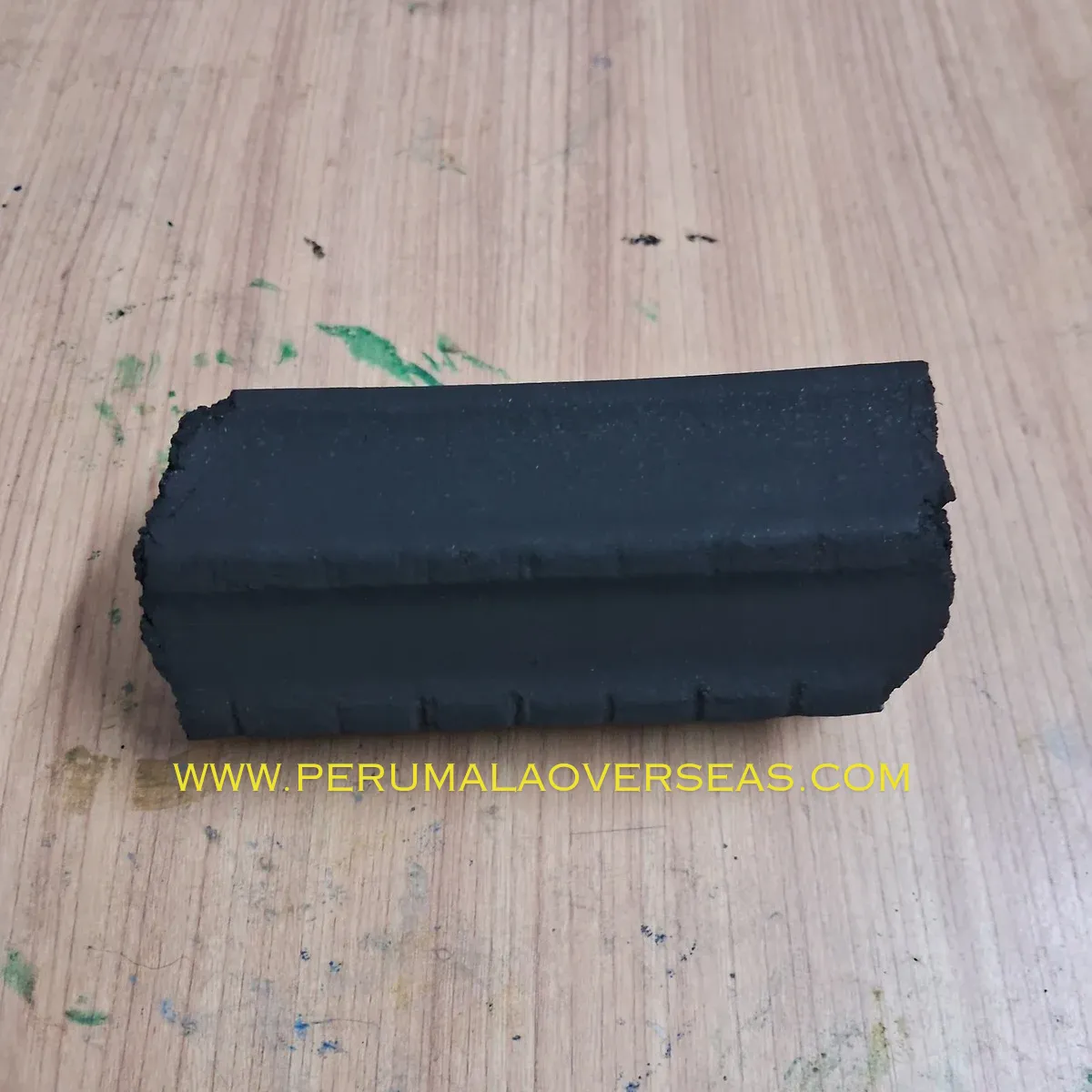
Product photographs can help buyers understand the appearance of different charcoal forms. Before a bulk order, however, always ask for a sample from the proposed supply batch and approve the exact grade in writing.
The gallery below shows charcoal product reference photographs provided for this article. Use them to begin a discussion about shape, surface, size and product type. They should not be treated as proof of current stock, a live factory inspection or a guarantee that every future batch will look exactly the same.
What should you check when you receive a sample?
- Shape: Are the briquettes cubes, fingers, hexagons or another agreed shape?
- Dimensions: Do the pieces match the size written in the specification?
- Density and strength: Do the briquettes remain firm during normal handling, or do they break too easily?
- Surface: Are there cracks, loose powder or damaged edges?
- Moisture: Has the sample been stored dry, and does the test result meet the agreed limit?
- Ash: Does the ash result meet the buyer's written requirement?
- Burning: Does the product perform correctly in the buyer's own equipment?
- Packaging: Does the packing protect the product during handling and transport?
Do not approve a container order only because a photograph looks good. Approve a physical sample, agree on the specification and record the quality requirements in the purchase documents.
Practical advice for international charcoal importersMoisture-Proof Export Packaging and Quality Control from India
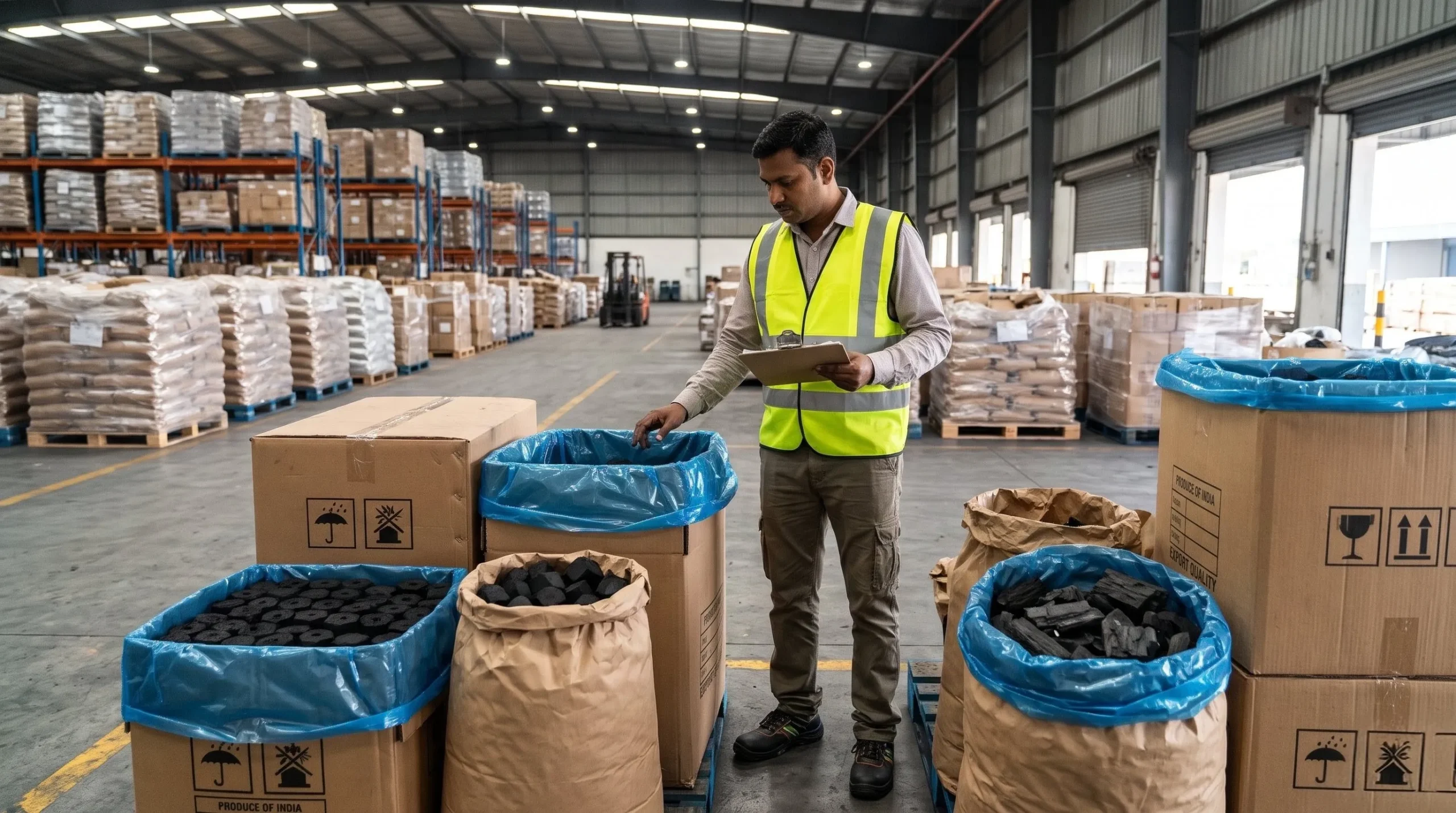
Charcoal may burn well before shipment, but poor storage or wet packaging can affect its condition during a long journey. Good export packing starts with the product, the bag and the expected transport conditions.
Why does moisture matter?
Charcoal is a fuel. If it absorbs too much water, it can become harder to light and may not perform as expected. Wet or damp bags can also create problems during storage and handling.
Sea journeys can expose cargo to changing temperatures and humidity. Condensation may form inside a container when warm, moist air meets a cooler surface. This is sometimes called container rain.
That is why buyers and exporters should plan packing, container preparation and moisture protection before the cargo is loaded.
What export packing options can be discussed?
The Perumala Overseas charcoal catalogue lists several packing formats, including:
- 5 kg retail boxes.
- 10 kg cartons.
- 20 kg PP bags.
- 25 kg jumbo bags.
- Private-label packing, subject to confirmation.
- Palletisation, where agreed and suitable for the shipment.
Depending on the buyer's product, destination and shipping plan, an inner liner or additional moisture barrier may also be specified. For example, a blue LDPE liner inside a suitable outer bag or carton can be discussed as an optional packing arrangement. The liner type, thickness, sealing method and final packing construction must be confirmed before order acceptance.
Do not assume that every charcoal order automatically includes a blue liner, kraft bag, corrugated carton or drop-test report. These are packing and inspection requirements that should be written into the order if the buyer needs them.
What does a pre-shipment quality check involve?
A pre-shipment check is a chance to compare the prepared cargo with the agreed order details before dispatch. Depending on the contract, the check may be performed by the buyer, an appointed inspector or another mutually agreed party.
Suggested charcoal shipment inspection checklist
- Confirm the product name and grade against the purchase order.
- Check the agreed raw material and briquette or lump size.
- Review moisture, ash and fixed-carbon test results where required.
- Check the quantity, bag count and net weight.
- Inspect bag stitching, seals, liners and carton condition.
- Confirm private-label artwork and shipping marks, if applicable.
- Check that the cargo is dry and suitable for packing.
- Record any agreed inspection findings before shipment.
Should buyers ask for a drop test?
A drop test can help assess whether a package can withstand a defined handling impact. But the test must use an agreed method, package weight, drop height and acceptance standard. A casual drop of a bag is not the same as a formal packaging test.
If a buyer needs a drop-test report, specify it before the order is confirmed. The parties should agree who will conduct the test and whether it will be performed on a sample package or the actual export packing.
Container loading and sea freight
Charcoal shipments are commonly moved by sea for wholesale quantities. The loading plan depends on the package size, net weight, container type, port, carrier restrictions and destination requirements.
The final container capacity should never be guessed from a general catalogue. It must be checked against the actual bag dimensions, cargo density, legal payload, container specifications and shipping line requirements.
Which Charcoal Is Best for Your Business?
The right product depends on who will use it and what they expect from it. Here is a simple way to choose.
For shisha lounges
Start with premium hookah-grade coconut shell briquettes. Ask for the cube size, ash limit, moisture, fixed carbon, burning time and smoke/odour requirements. Test the charcoal with your own shisha equipment.
For BBQ restaurants
Compare BBQ-grade coconut briquettes and hardwood lump charcoal. Consider how long the kitchen needs heat, how quickly it needs to start cooking and whether a natural wood aroma is wanted.
For steakhouses
Hardwood lump charcoal may suit kitchens that prefer irregular natural pieces and a wood-fired cooking style. Test the heat level and piece size in the actual grill.
For wholesale distributors
Consider the needs of your customers. You may need more than one grade, such as shisha cubes for lounges and BBQ briquettes or hardwood lump for restaurants.
Questions to ask before choosing
- Will the charcoal be used for shisha, BBQ, restaurant cooking or another purpose?
- What is the required piece size and shape?
- How long should the charcoal burn in the buyer's equipment?
- What ash percentage can the customer accept?
- Is a natural wood aroma wanted, or should unwanted odour be kept low?
- Does the buyer need retail boxes, private labels or bulk bags?
- What is the destination country and port?
- What quantity is required for the first order and repeat orders?
- Will the buyer require laboratory testing or third-party inspection?
If you are unsure, do not choose by price alone. Tell the exporter how you will use the charcoal. A clear application helps the supplier recommend the correct grade for sampling.
Perumala Overseas — Buyer-first sourcing approachBuying Charcoal from India: How Perumala Overseas Supports International Enquiries
An overseas buyer may know exactly what product is needed but still have questions about supplier communication, specifications, documents, packing and shipment. A clear export process helps bring these details together.
Perumala Overseas is an India-based merchant exporter, importer and international sourcing partner located in Kolkata, West Bengal. We work to connect international buyers with selected Indian products and coordinate sourcing and export discussions based on the buyer's requirements.
Our charcoal product range includes hardwood lump charcoal, coconut shell charcoal in raw form, BBQ-grade coconut shell briquettes, hookah/shisha briquettes and sawdust charcoal briquettes. Product availability, supplier allocation, specifications, pricing and shipment schedules must be confirmed for each enquiry.
We do not ask buyers to rely only on a product photograph or a general description. We encourage importers to share their intended use, technical requirements, quantity, packing needs and destination so that the correct product can be discussed.
How a wholesale charcoal enquiry works
- Send your requirement: Tell us whether you need coconut shell shisha charcoal, BBQ briquettes, hardwood lump or another charcoal product.
- Share the specification: Confirm size, shape, ash, moisture, fixed carbon, burning time and any other important requirement.
- Discuss samples: Where available and commercially agreed, review a sample before confirming a bulk order.
- Confirm packing: Agree on bag size, inner liner, carton, pallet, private label and shipping marks.
- Receive a quotation: Review the product, quantity, price, currency, delivery term, port and payment terms.
- Confirm the order: Approve the Proforma Invoice and final specifications before the order proceeds.
- Coordinate shipment: Confirm inspection, export documents, loading plan and shipment arrangements according to the agreed terms.
What export documents may be involved?
The exact documents depend on the product, destination country, payment method, delivery term and applicable customs requirements. Common documents in an export transaction may include:
- Proforma Invoice: A preliminary commercial offer showing the proposed product, quantity, price and terms.
- Commercial Invoice: The final commercial document recording the sale details.
- Packing List: Shows package count, packing type, weights and dimensions.
- Shipping Bill: The Indian customs export declaration for the shipment.
- Bill of Lading: The sea transport document issued for the cargo.
- Certificate of Origin: May be requested by the buyer or destination customs authority.
- Inspection or laboratory report: Required when agreed by the buyer or applicable rules.
- Insurance document: Where cargo insurance is arranged under the agreed sale and transport terms.
Not every shipment needs every document above. The final list should be checked before shipment with the buyer, freight forwarder, customs broker and relevant authorities.
FOB or CIF: what should an importer understand?
FOB and CIF are Incoterms used in international trade. They explain which party has particular costs, responsibilities and risks at different stages of the shipment. They do not replace the need for a clear sales contract.
| Point | FOB | CIF |
|---|---|---|
| Full name | Free On Board | Cost, Insurance and Freight |
| Sea freight | Normally arranged by the buyer. | Arranged and paid by the seller to the named destination port. |
| Insurance | Not a seller insurance obligation under FOB. | Seller arranges the insurance required by CIF, subject to the Incoterms rules. |
| Risk transfer | When goods are on board the vessel at the named port of shipment. | Risk also transfers when goods are on board at the shipment port, even though the seller pays freight and insurance to the destination port. |
| Best suited for | Buyers who want to arrange their own main sea freight. | Buyers who want the seller to arrange and pay main sea freight and the required insurance. |
The named port and the exact Incoterms version should be written clearly in the quotation and contract. FOB and CIF are intended for sea and inland waterway transport. For container shipments handed to a carrier before being loaded on board, buyers should discuss whether another Incoterm, such as FCA or CIP, is more suitable.
How can an overseas buyer check our business information?
International buyers should carry out their own checks before sending funds or placing a large order. Review the business details, registration documents, contact information, Proforma Invoice and beneficiary bank details carefully.
You can visit our Business Verification page to review the business information and documents made available there. If anything is unclear, contact us using the official email address or phone number shown on our website.
For general company information, visit Perumala Overseas Kolkata. We welcome enquiries from shisha lounge groups, BBQ distributors, restaurant buyers, importers and wholesale trading companies.
Common Mistakes Charcoal Importers Should Avoid
A low quotation may look attractive, but a poor product match can cost more after the cargo arrives. These simple checks can help buyers avoid common problems.
1. Buying without a clear grade
“Coconut charcoal” is not enough information. Raw coconut shell charcoal, BBQ briquettes and hookah briquettes are different products. Write the exact product grade in the enquiry and purchase order.
2. Comparing different specifications
One supplier may quote a hookah briquette and another may quote a BBQ briquette. Their ash, moisture, fixed carbon and burn time may be different. Compare like with like.
3. Trusting a burn-time claim without testing
Burn time changes with piece size, airflow, burner, grill design and how the product is used. Ask how the supplier measured it and test the sample in your own equipment.
4. Ignoring moisture
Damp charcoal can be difficult to light and may not perform as expected. Agree on a moisture limit and decide how it will be checked.
5. Forgetting packaging details
A price per tonne does not tell you what bag, liner, carton or label is included. Ask for the full packing specification and confirm it in writing.
6. Not checking the import rules
The importing country may have rules about wood products, charcoal, packaging, labelling, safety, customs classification or other matters. Check the destination requirements before placing the order.
7. Sending money before checking documents
Verify the supplier identity, signed quotation or Proforma Invoice, beneficiary name and bank details through a trusted channel. Be careful if bank details suddenly change by email or a message.
8. Not agreeing on inspection
If third-party inspection is important, agree on the inspection company, timing, sample method, tests, acceptance limits and cost before the order is confirmed.
Before you pay: buyer's quick checklist
- Have I received the exact product specification?
- Have I reviewed or approved a sample?
- Are the quantity, price and currency clear?
- Are the Incoterm and named port written correctly?
- Are the payment stages and due dates clear?
- Are the packing details and inspection terms agreed?
- Have I independently checked the seller and bank details?
- Have I checked the import rules in my country?
Frequently Asked Questions About Coconut Shell and Hardwood Charcoal
1. Which is better for shisha: coconut charcoal or hardwood charcoal?
Premium coconut shell hookah briquettes are generally the more suitable choice for shisha. They are made in regular shapes and are designed for low unwanted odour and low visible smoke after proper lighting. Hardwood lump charcoal is not normally the first choice for standard shisha use.
2. Is coconut shell charcoal smokeless?
Premium hookah-grade briquettes are designed to produce very little visible smoke and unwanted odour once properly lit. No charcoal should be described as producing zero emissions. Always use suitable ventilation because burning charcoal produces carbon monoxide.
3. How long does coconut shell shisha charcoal burn?
The Perumala Overseas catalogue lists an indicative burning time of 90–150 minutes for premium hookah/shisha briquettes. Actual time depends on cube size, density, airflow, burner and use.
4. How long do BBQ coconut shell briquettes burn?
The catalogue lists around 2–4 hours for BBQ-grade coconut shell briquettes, depending on size and conditions. Buyers should test the product in their own BBQ equipment.
5. Does hardwood lump charcoal burn hotter?
Hardwood lump can reach high cooking temperatures and is often used for fast searing. But actual heat depends on the wood, size, moisture, airflow and grill. It is better to compare tested performance than rely on a general statement.
6. Which charcoal produces less ash?
The catalogue lists 2–4% ash for hookah-grade coconut briquettes and 3–6% for BBQ-grade coconut briquettes. Hardwood lump is listed at 4–12%. The actual result depends on the batch and test method.
7. What is the difference between BBQ briquettes and shisha briquettes?
They are made for different uses. Hookah briquettes are designed around shisha requirements such as shape, ash and unwanted odour. BBQ briquettes are designed for cooking heat. Do not assume one grade can replace the other.
8. What shapes are available for coconut shell briquettes?
The catalogue lists hexagonal, pillow and cube shapes for BBQ briquettes, and cube, finger and hexagonal shapes for hookah/shisha briquettes. Final shape, dimensions and availability must be confirmed for each order.
9. Can I order private-label charcoal?
Private-label packing is listed as an option in the charcoal catalogue. Buyers should share their artwork, bag or carton size, label requirements, order quantity and destination. The final arrangement is subject to supplier and packing confirmation.
10. What packing sizes are available?
Catalogue packing options include 5 kg retail boxes, 10 kg cartons, 20 kg PP bags and 25 kg jumbo bags. The suitable packing format depends on the product and buyer's requirements.
11. Can I request a sample before a container order?
You can ask us to discuss sample availability and the sample arrangement for your product. Sample cost, courier charges, quantity and dispatch timing must be confirmed before proceeding.
12. Can a third-party inspection be arranged?
Third-party inspection can be discussed where required by the buyer. The inspection company, scope, timing, tests and cost should be agreed before the order is confirmed.
13. Which HS code is used for charcoal?
The Perumala Overseas catalogue gives HS heading 4402 for charcoal products. The correct detailed tariff code depends on the exact product and the importing country's tariff schedule. Confirm the final classification with a customs professional or relevant authority.
14. Can Perumala Overseas quote FOB or CIF prices?
Buyers can request an FOB or CIF quotation. The offer depends on the product, quantity, packing, named port, destination port, freight and insurance availability, and the agreed Incoterms. Ask for the exact named place or port in the quotation.
15. Which details should I send to get a wholesale quotation?
Send the product name, intended use, required grade, size or shape, quantity, packing preference, destination country, destination port and preferred delivery term. Include any test or inspection requirements.
16. Is Perumala Overseas a manufacturer?
Perumala Overseas operates as a merchant exporter, importer and international sourcing partner. Product sourcing and supply arrangements are coordinated according to each enquiry. Buyers should confirm the specific supplier, production details and order arrangements during the quotation process.
17. How can I verify Perumala Overseas?
Visit our Business Verification page to review the business information and available documents. You can also contact us through the official email and phone number published on our website.
Final Verdict: The Best Charcoal Is the One That Fits Your Customer
Coconut shell charcoal and hardwood lump charcoal both have an important place in the international charcoal market. But they serve different needs.
If you operate a shisha lounge or supply hookah products, premium coconut shell briquettes are usually the better starting point. Their regular shapes, low-ash target and low unwanted odour make them suitable for this type of use when the product is made and tested correctly.
If you run a steakhouse, BBQ restaurant or open-fire cooking business, hardwood lump charcoal may be a better match. It offers natural irregular pieces and can provide strong cooking heat with a wood-fired character.
If you supply BBQ distributors, compare BBQ-grade coconut briquettes and hardwood lump using the same cooking test, price basis and quality requirements. Look at the cost per useful cooking hour, not only the price per tonne.
Remember these five points before importing
- Choose the correct grade: shisha, BBQ or hardwood lump.
- Check fixed carbon, ash, moisture, size and calorific value.
- Test burn time and heat performance in your own equipment.
- Agree on packaging, inspection and shipment terms in writing.
- Verify the exporter, commercial documents and payment details before sending funds.
At Perumala Overseas Kolkata, we welcome enquiries from international shisha lounge owners, BBQ and restaurant groups, charcoal distributors, importers and wholesale buyers. Share your requirement clearly so we can review the product and discuss the next steps.
Product Catalogues, Export Information and Other Product Categories
If you are exploring more products from India, use the links below to visit our product pages and company information. These pages cover charcoal, jute products, handicrafts and business information.
Visit the Perumala Overseas homepage for an overview of our business and product categories.
Looking for a Coconut Shell Charcoal or Hardwood Lump Supplier from India?
Whether you are importing shisha charcoal for a hookah lounge, BBQ briquettes for restaurants, or hardwood lump charcoal for wholesale distribution, Perumala Overseas welcomes your business enquiry.
Tell us the product you need, required specification, quantity, packing preference and destination country. We can review your enquiry and discuss the available sourcing and export options. Final price, product availability, specifications, inspection and shipment schedule are confirmed individually for each order.
To help us reply faster: Include your product, grade, quantity, packing requirement, destination country and preferred Incoterm in your message.