

The Global Shift from Plastic to Jute: Why Retail Brands are Switching in 2027
How sustainable jute packaging, custom jute shopping bags and responsible sourcing are becoming important considerations for international retailers, procurement teams and businesses preparing for a more sustainability-conscious global market.

The global packaging industry is entering an important period of change. Retailers, supermarkets, consumer brands and international procurement teams are taking a closer look at the materials they use to package, carry and present their products.
For many years, lightweight plastic bags became a convenient choice because they were inexpensive, easy to manufacture and simple to distribute. However, the environmental challenges associated with single-use plastic waste have encouraged governments, businesses and consumers to reconsider their packaging decisions.
As businesses prepare for 2027 and beyond, sustainable jute packaging is receiving renewed attention. Jute is a natural plant-based fibre traditionally cultivated and processed in several regions, including India. It can be used to produce shopping bags, promotional bags, sacks, twine, fabrics and other packaging products.
The shift is not simply about replacing one bag with another. It is about examining the complete packaging decision: material sourcing, durability, product protection, transportation, branding, reuse, disposal and the environmental requirements of the destination market.
For international buyers searching for an Indian merchant exporter capable of coordinating jute product sourcing and export requirements, understanding these factors is essential before placing a commercial order.
The Corporate ESG Mandate: Why Sustainable Packaging Is Becoming a Business Priority
Environmental, Social and Governance (ESG) considerations are increasingly influencing how companies evaluate suppliers, packaging materials and supply-chain decisions.
ESG is a way of examining how a business manages its environmental impact, its relationships with people and its internal standards of responsibility. Large retailers, multinational brands and institutional buyers may consider ESG information when selecting suppliers or reviewing their purchasing practices.
Understanding ESG in simple language
Environmental
How a business uses natural resources, manages waste, considers emissions and evaluates the environmental effects of its products and operations.
Social
How a business treats workers, suppliers, communities and other people connected to its operations and supply chain.
Governance
How a business manages transparency, accountability, business conduct, documentation and responsible decision-making.
Supply-chain responsibility
How a company evaluates the materials, processes, suppliers and logistics partners involved in delivering a product.
What are Scope 1, Scope 2 and Scope 3 emissions?
A common topic in corporate climate reporting is greenhouse gas emissions. The Greenhouse Gas Protocol groups emissions into three broad categories, commonly called Scopes.
| Emission category | Simple explanation | Example |
|---|---|---|
| Scope 1 | Direct emissions from sources owned or controlled by a company. | Fuel burned in company-owned vehicles or boilers. |
| Scope 2 | Indirect emissions from purchased electricity, steam, heating or cooling. | Electricity consumed in a company's office or facility. |
| Scope 3 | Other indirect emissions occurring across the company's value chain. | Purchased materials, supplier activities, transportation, product use and end-of-life treatment, depending on the reporting category. |
Scope 3 is particularly relevant to packaging procurement because it can include emissions associated with purchased goods and services, upstream transportation and other value-chain activities.
For example, a retail company purchasing thousands of shopping bags may need to understand the materials used, how those materials are sourced, how the bags are manufactured and how the finished products reach its distribution centres.
Choosing jute does not automatically prove that a company has reduced its total emissions. A meaningful comparison requires reliable information about the materials, production methods, transport distances, product lifetime and end-of-life treatment of the alternatives being compared.
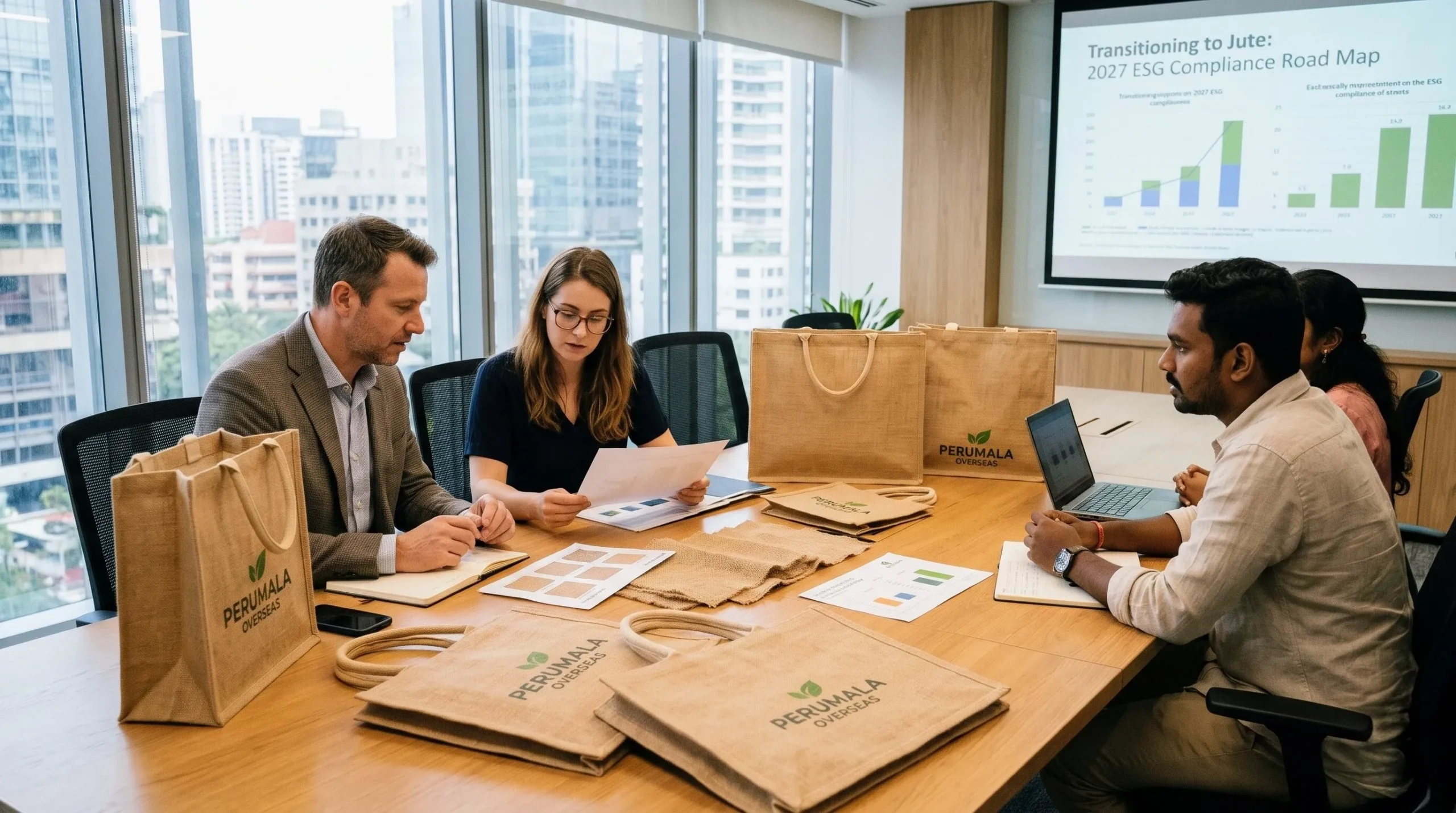
Why biodegradable fibres attract attention
Jute is a natural lignocellulosic fibre obtained from plants. Unlike conventional petroleum-based plastic, it is a plant-derived material. Under suitable biological conditions, untreated natural jute fibres can biodegrade.
This characteristic makes jute an interesting option for businesses exploring alternatives to certain single-use plastic products. However, the actual environmental outcome depends on the complete product.
- Material composition: A bag made primarily from natural jute has a different material profile from a bag containing plastic film, synthetic coatings or mixed-material components.
- Product life: A reusable bag should be used repeatedly if its environmental value is to be assessed fairly.
- Finishing and lamination: Plastic coatings, inks, adhesives and handles can affect recyclability and end-of-life treatment.
- Disposal conditions: Biodegradation depends on the environment and the materials present. It should not be treated as an unconditional guarantee.
- Transportation: Shipping distance, packaging density and transport mode also matter when evaluating environmental impact.
Regulatory pressure and responsible procurement
Governments and regional authorities are using different approaches to address plastic waste. Depending on the market, these may include restrictions on selected single-use plastic products, producer responsibility requirements, packaging-waste rules, labelling provisions and reporting obligations.
The European Union, for example, has introduced packaging and packaging-waste rules through its regulatory framework. Other markets have their own national and regional requirements. The exact obligations depend on the product, material, packaging format, business role and destination country.
This is why international buyers should not assume that a product described as “eco-friendly” is automatically compliant with every destination-market regulation. They should check the applicable rules before importing or distributing packaging products.
“Sustainable packaging is not established by a label alone. It is established through material transparency, suitable product design, responsible sourcing and evidence that supports the claims being made.”
Perumala Overseas — Responsible sourcing perspectiveWhat procurement teams should ask suppliers
- What is the main material used in the bag or packaging product?
- Does the product contain plastic lamination, synthetic lining or mixed-material components?
- Can the supplier provide material composition details?
- Are product dimensions, fabric specifications and construction details documented?
- Are printing inks, coatings or treatments relevant to the buyer's intended use?
- Can the supplier provide samples and supporting documents for evaluation?
- What destination-market regulations should the importer review?
Supermarkets and Retail Checkouts: How Custom Jute Shopping Bags Create Brand Value
A shopping bag is more than a way to carry products. For a retailer, it can also become a reusable brand asset that customers take home and use again.
Supermarkets, fashion retailers, lifestyle stores, organic product shops and specialty retailers are exploring reusable bag options as part of their packaging and brand-presentation strategies.
Custom jute shopping bags are particularly interesting for businesses that want a natural-texture appearance, practical carrying capacity and space for brand communication.
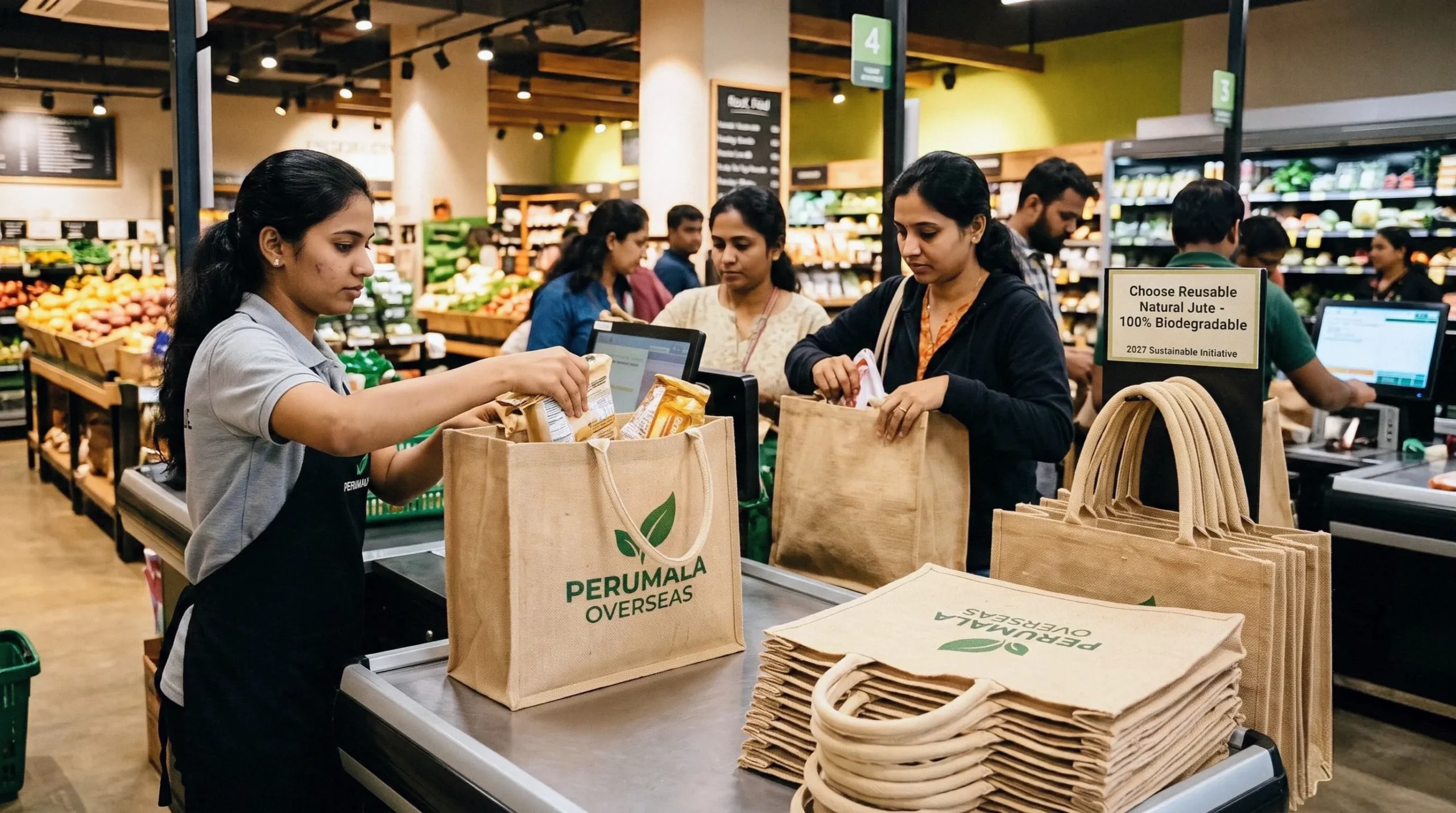
Why retailers consider jute shopping bags
1. A natural and distinctive appearance
Jute has a recognisable woven texture and natural appearance. This can complement brands that want to communicate an association with traditional materials, natural products, handmade aesthetics or responsible packaging choices.
2. Reusable retail packaging
A well-designed jute bag can be used for grocery shopping, daily carrying, gifting or general storage, depending on its construction and intended load. Repeated use can make it more useful to customers than a bag designed for a single shopping trip.
3. A practical branding surface
Retailers can consider adding their logo, campaign artwork, brand colours, product messages or promotional designs. The printing method and artwork should be selected according to the fabric, design complexity, order quantity and intended use.
4. Multiple formats for different retail needs
Jute bags can be developed in different formats, including shopping totes, promotional bags, wine bottle bags, gift bags and other carrying styles.
Supermarket shopping bags
Designed around carrying capacity, handle construction, dimensions and the retailer's preferred appearance.
Promotional jute bags
Useful for exhibitions, corporate events, campaigns, product launches and promotional distribution.
Retail gift bags
Suitable for selected gift shops, lifestyle brands, boutiques and premium retail presentations.
Private-label tote bags
Developed around a buyer's branding requirements, subject to artwork, production feasibility and order confirmation.
How to plan a custom jute shopping bag order
A successful private-label order begins with a clear product specification. Buyers should avoid requesting a quotation using only the phrase “jute shopping bag,” because that description does not provide enough information to calculate a reliable price.
Buyer specification checklist
- Bag width, height and gusset depth.
- Fabric type, approximate weight or required construction.
- Handle material, length and stitching preference.
- Natural, dyed, laminated or lined finish.
- Logo size, artwork file and printing colours.
- Required quantity per design and total order quantity.
- Individual packing, carton packing and shipping marks.
- Destination country and intended retail use.
- Required delivery schedule and preferred Incoterm.
Buyers should also request a sample or pre-production approval where appropriate. This helps confirm the size, appearance, handle construction, printing quality and other important details before a larger order proceeds.
Technical Logistics Comparison: Jute, Breathability, Moisture and Plastic Lamination
Selecting packaging material is a technical decision. The correct choice depends on the product being packed, the transportation environment, storage duration and the protection required.
Jute and plastic packaging do not perform in exactly the same way. Jute is a woven natural fibre material, while conventional plastic packaging can be produced in many forms, including films, sacks, liners and laminated structures.
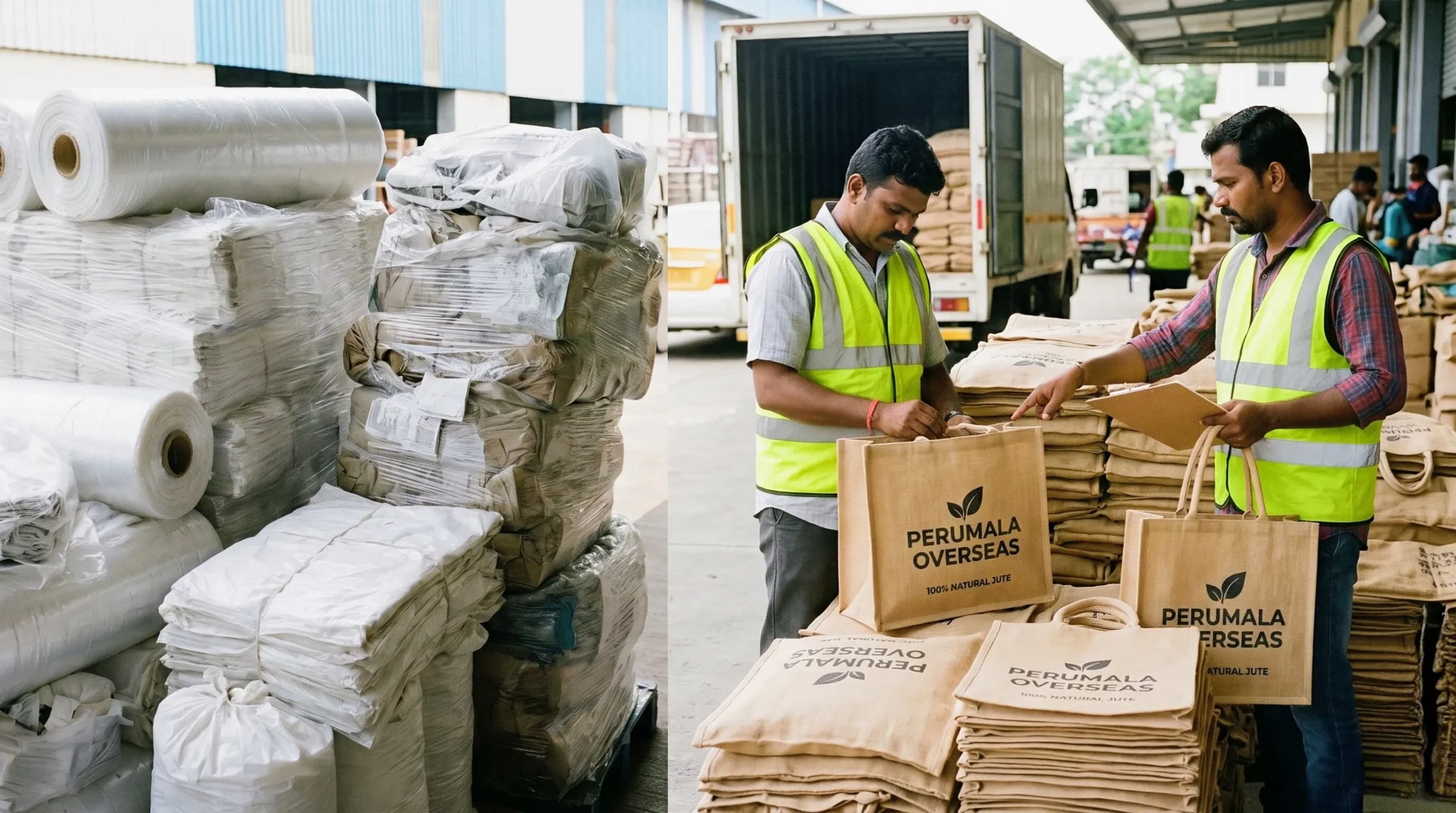
Natural breathability: when it matters
Woven jute fabric has spaces between its fibres. Depending on the weave, fabric weight and construction, this allows air to move through the material more readily than through an impermeable plastic film.
This characteristic may be useful for certain dry agricultural and bulk-product packaging applications where ventilation is an important consideration. However, breathability is not automatically an advantage for every product.
Products that need a moisture barrier, protection from external contamination or controlled storage conditions may require a different packaging construction. The buyer should assess the actual product and shipping environment before choosing a material.
Moisture control and storage considerations
Jute is a natural fibre and can absorb moisture. This means that storage, container preparation and transportation conditions deserve attention.
- Keep jute products dry before packing and dispatch.
- Store finished bags away from direct water exposure.
- Use suitable inner packaging where the cargo requires additional protection.
- Check container cleanliness and dryness before loading.
- Consider humidity, condensation and voyage duration when planning export packaging.
- Confirm any destination-specific requirements for the intended cargo.
What is LDPE lamination?
LDPE stands for Low-Density Polyethylene. It is a type of plastic commonly used in films and coatings.
In a laminated jute bag, a plastic layer may be applied to provide an additional barrier against moisture or other external conditions. The performance depends on the film, thickness, bonding process, seams and overall bag construction.
Lamination can be useful in selected applications, but it changes the material composition of the finished product. A laminated jute bag should not automatically be described as fully biodegradable, plastic-free or easily recyclable.
| Consideration | Natural woven jute | LDPE or plastic-based packaging |
|---|---|---|
| Material origin | Plant-derived natural fibre. | LDPE is a petroleum-derived plastic polymer. |
| Air movement | Can allow air movement through the weave. | Plastic film generally provides a much stronger barrier to air movement. |
| Moisture protection | Natural woven fabric alone offers limited moisture protection. | Film and suitable plastic structures can provide moisture barriers. |
| Reuse potential | Can be reusable depending on construction and care. | Varies significantly by product design and thickness. |
| End-of-life considerations | Untreated natural fibre may biodegrade under suitable conditions; mixed materials can change this. | Disposal and recycling depend on local facilities and the specific plastic structure. |
| Suitable applications | Selected sacks, shopping bags, promotional bags and other dry-use packaging. | Applications requiring specific barrier properties or moisture protection. |
Does natural jute automatically qualify as food-grade packaging?
No. A natural fibre material should not automatically be treated as approved for direct food contact.
Buyers importing bags for food, agricultural commodities or other sensitive products should specify the intended use and confirm the applicable food-contact requirements. Depending on the application, they may need information about the fabric, manufacturing process, dyes, inks, coatings, inner liners and relevant test reports.
Where direct food contact is required, the importer should obtain suitable evidence from the supplier and verify compliance with the regulations applicable in the destination market.
How packaging affects export logistics
Export packaging must be considered together with cargo weight, volume, stacking arrangement, handling method and transportation conditions.
For example, a large quantity of empty shopping bags may be lightweight but occupy considerable container space. A compact packing design can therefore influence freight economics. Conversely, tightly compressed or poorly packed goods may be damaged or difficult to handle.
A buyer and exporter should review the packing method, carton dimensions, gross weight, net weight and loading plan before shipment confirmation.
Scaling Global Sourcing: How an Indian Merchant Exporter Coordinates Jute Orders
International buyers need more than a product supplier. They need clear communication, accurate specifications, commercially practical documentation and a coordinated export process.
India has a long-established jute industry, with West Bengal playing an important role in the country's jute ecosystem. Kolkata is also a significant commercial and logistics location for businesses involved in sourcing and international trade.
For buyers seeking an Indian merchant exporter, a sourcing partner can help coordinate product requirements with suitable suppliers and support the commercial and documentation stages of an export order.
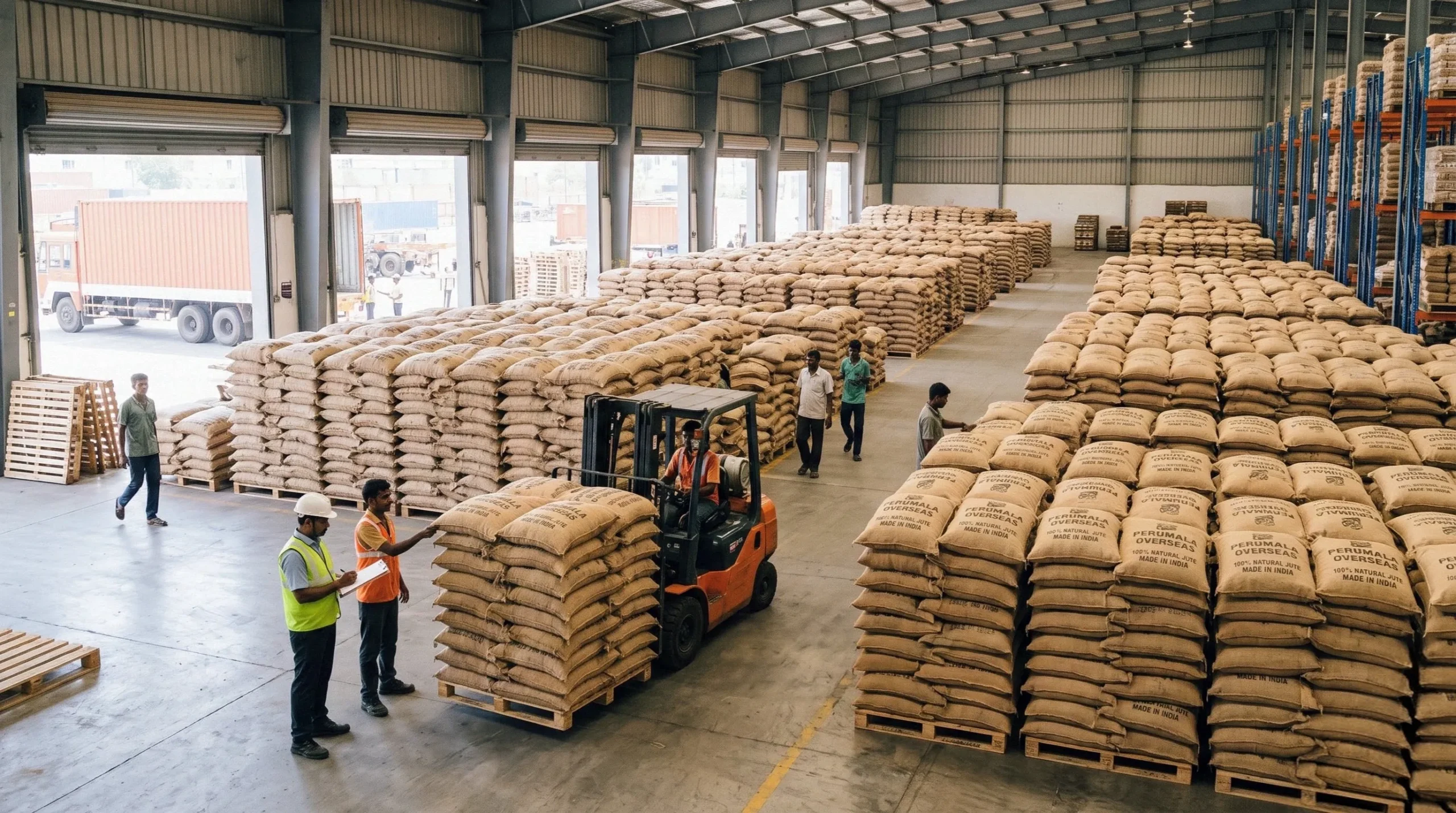
How Perumala Overseas approaches export sourcing
Perumala Overseas is a Kolkata-based merchant exporter, importer and international sourcing partner. The business focuses on connecting international buyers with selected Indian products and coordinating the requirements involved in cross-border trade.
For jute product enquiries, the process begins with understanding the buyer's requirements. Product type, intended use, dimensions, fabric construction, branding, quantity and destination are important inputs before sourcing and quotation discussions can proceed.
Step 1: Understanding the buyer's requirement
The buyer shares the product description, quantity, destination country, preferred packaging and any technical or branding requirements.
A detailed enquiry helps avoid confusion between different product types. For example, a jute shopping bag, a jute gunny bag and a laminated jute sack may use the same broad fibre category but have different constructions and commercial purposes.
Step 2: Product and supplier coordination
The sourcing requirement is reviewed to identify a suitable product and supplier option. Availability, specifications, production feasibility, order quantity and commercial terms must be confirmed before a firm offer is made.
A merchant exporter should communicate clearly about what is confirmed and what remains subject to supplier approval. Buyers should receive a clear understanding of the agreed product rather than relying on a general catalogue description.
Step 3: Private-label printing and product customisation
Many international buyers want their own brand identity on the finished bags. Depending on the product and supplier capability, customisation may include:
- Buyer logo and brand artwork.
- Printed promotional messages.
- Custom bag dimensions and gusset design.
- Handle style and construction.
- Selected fabric colours and finishes.
- Retail or export carton labelling.
- Private-label presentation and packing instructions.
Artwork, colour references, printing position and sample approval should be confirmed before bulk production. This is particularly important when the buyer is ordering for a retail launch, marketing campaign or seasonal promotion.
Step 4: Commercial quotation and order confirmation
A proper quotation should identify the product, agreed specification, quantity, unit price, currency, packing basis, delivery term, estimated production schedule and quotation validity.
The buyer and exporter should also agree on payment terms and the documents required for the transaction. Depending on the order, the commercial process may involve a Proforma Invoice, purchase order and mutually agreed specifications.
Step 5: Export documentation and shipment coordination
Export documentation depends on the product, destination, buyer's requirements, payment arrangement and applicable Indian export procedures.
Common export documents may include:
- Commercial Invoice: Records the sale, goods description, quantity, price and other commercial details.
- Packing List: Provides package-wise information such as carton count, dimensions, net weight and gross weight.
- Shipping Bill: The customs export declaration filed through the applicable customs process.
- Bill of Lading or Air Waybill: Transport documents issued for the relevant mode of shipment.
- Certificate of Origin: May be required to establish the country of origin or support a buyer's import requirements.
- Insurance Document: Required where insurance is arranged under the agreed commercial terms.
- Inspection or Test Documents: Required where specified by the buyer, product or destination regulations.
The final document set must be determined for the actual transaction. Not every export shipment requires every document listed above.
Step 6: Cargo handling and container loading
For sea freight, the exporter, freight forwarder, transport providers and relevant warehouse or stuffing service providers coordinate the movement and loading of cargo according to the agreed shipment plan.
For an order moving through Kolkata or another Indian port, the practical route and loading location depend on the cargo, supplier location, port selection, freight availability and the buyer's agreed delivery term.
Before container loading, the parties should confirm the cargo quantity, packing condition, shipping marks, container suitability, loading arrangement and required shipment documents.
“A successful export order is built on clear specifications, transparent commercial terms, reliable coordination and accurate documentation—not simply on finding a product at the lowest price.”
Perumala Overseas — Export coordination approachWhy buyers work with a merchant exporter
One point of coordination
Buyers can communicate their requirements through one commercial contact who coordinates the relevant sourcing and export discussions.
Product sourcing support
A merchant exporter can help explore suitable Indian product and supplier options based on the buyer's requirements.
Export documentation support
Commercial and shipping documentation can be coordinated according to the agreed transaction and applicable procedures.
Custom order communication
Product specifications, artwork, packing instructions and buyer requirements can be discussed before order confirmation.
The exact scope of support, supplier allocation, production schedule, inspection arrangements and shipment responsibilities should always be recorded in the commercial agreement or order documents.
Conclusion: Building Practical Business Value Through Sustainable Jute Packaging
The global discussion around plastic waste, responsible sourcing and corporate sustainability is changing how businesses evaluate packaging. As retailers and procurement teams prepare for 2027, material selection is increasingly connected to brand identity, supply-chain transparency, product performance and destination-market requirements.
Jute offers a natural plant-based material option for selected shopping bags, promotional products, sacks and other packaging applications. Its recognisable texture, potential for reuse and suitability for different bag formats make it relevant to buyers exploring alternatives to certain plastic packaging products.
However, choosing jute should be a considered commercial decision. Buyers must evaluate the exact construction, moisture requirements, intended use, printing, lamination, packaging, transportation and end-of-life considerations. They should also verify any environmental or regulatory claims before using them in their own marketing.
For international buyers, working with an experienced sourcing and export coordination partner can make the enquiry and order process easier to manage. Clear communication, detailed specifications and accurate documentation are essential from the first enquiry through shipment.
What international buyers should remember
- Choose packaging based on the actual product and its intended use.
- Compare natural jute and plastic using the complete product lifecycle, not only the raw material.
- Specify dimensions, fabric, handles, printing and packing before requesting a final quotation.
- Confirm food-contact suitability and destination-market compliance where applicable.
- Request samples and approve artwork before bulk production.
- Agree on payment terms, Incoterms, shipment responsibilities and documentation in writing.
- Work with a sourcing partner that communicates clearly about confirmed details and order conditions.
Looking for Jute Packaging from India?
Whether you are sourcing custom jute shopping bags, promotional jute bags, jute tote bags or other jute packaging products, Perumala Overseas welcomes enquiries from international importers, retailers, wholesalers and sourcing professionals.
Share your product specifications, estimated quantity, branding requirements and destination country. We can review your enquiry and discuss the available sourcing and export coordination options.